
- -10%

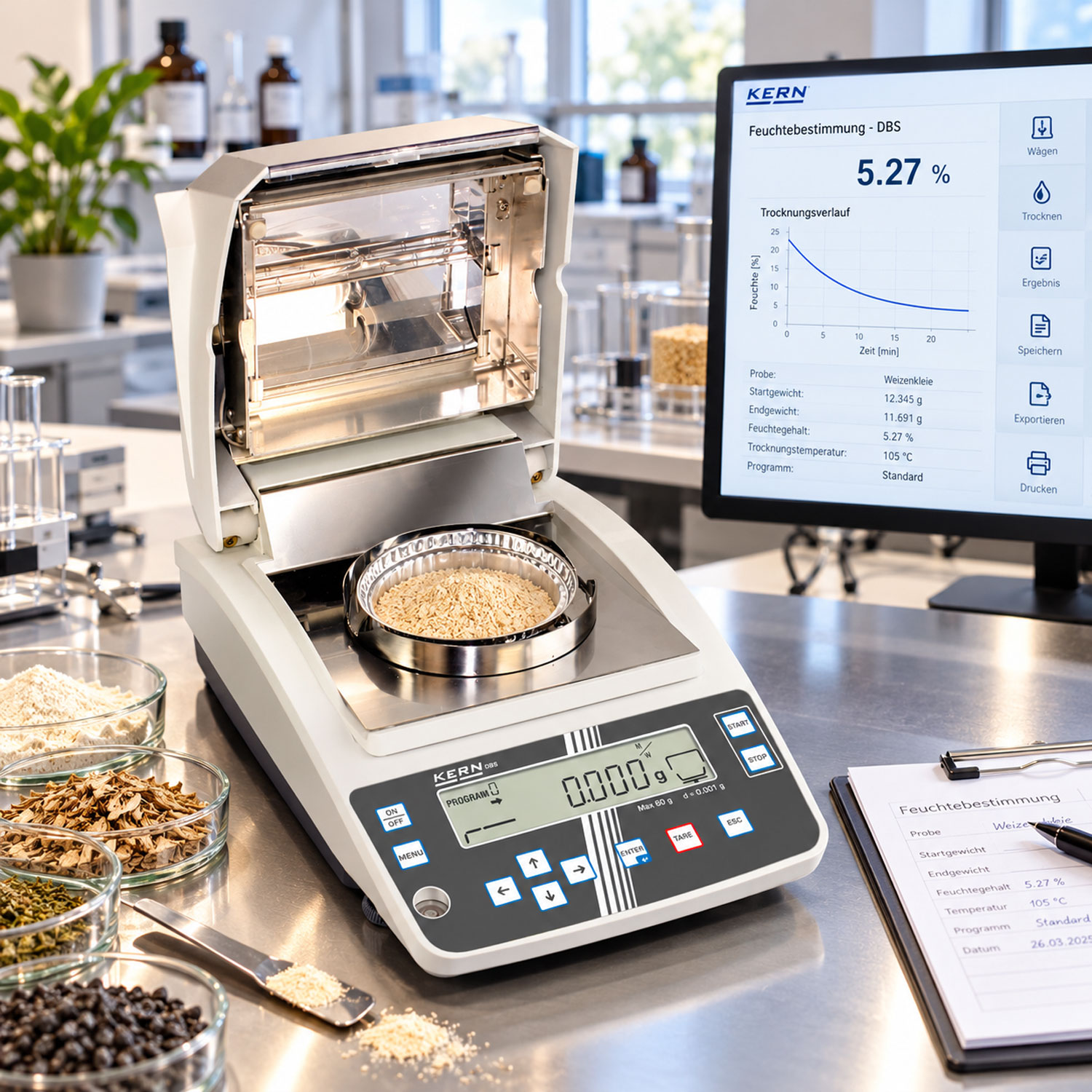
The KERN DBS 60-3 moisture analyzer is a professional laboratory instrument designed for thermogravimetric moisture determination, dry matter analysis, and loss-on-drying measurements.
Combining an advanced Single-Cell weighing system, powerful halogen heating, and intelligent method management, the KERN DBS provides a comprehensive solution for laboratories and industrial quality control departments that require repeatable, well-documented analytical procedures.
Unlike basic moisture balances, the KERN DBS offers four selectable drying profiles, programmable drying methods, integrated result storage, and convenient data transfer capabilities.
These features make it particularly attractive for laboratories working with different materials, standardized testing procedures, and recurring quality control tasks.
Advanced Single-Cell weighing technology
60 g maximum weighing capacity
0.001 g weighing readability
0.01% moisture display resolution
400 W halogen quartz-glass heating system
Adjustable drying temperature from 50 °C to 200 °C
Four drying profiles: Standard, Rapid, Gentle, and Step
Storage for 10 individual drying programs
Memory for 100 measurement results
Up to 99 programmable sample identifications
Password protection for stored settings
Backlit graphical LCD display
USB interface for data transfer
RS-232 interface listed in the technical specifications
50 sample pans included
The KERN DBS is designed for professional applications in food production, chemical manufacturing, plastics processing, environmental analysis, research laboratories, and industrial quality assurance.
At the heart of the KERN DBS 60-3 is its Single-Cell weighing system.
This technology is designed to deliver stable weighing performance, reliable operation, and fast response characteristics.
The instrument provides a maximum weighing capacity of 60 g with a readability of 0.001 g.
Its moisture display resolution is 0.01%.
The weighing system offers a specified repeatability of 0.001 g and linearity of ±0.003 g.
With a stabilization time of approximately three seconds under suitable laboratory conditions, the DBS provides a capable platform for routine and advanced moisture testing.
The Single-Cell system is particularly interesting for laboratories requiring consistent weighing performance throughout repeated analytical procedures.
However, the accuracy of the final moisture result also depends on sample preparation, drying parameters, environmental conditions, and method suitability.
| Specification | KERN DBS 60-3 |
|---|---|
| Maximum weighing capacity | 60 g |
| Weighing readability | 0.001 g |
| Moisture display resolution | 0.01% |
| Weighing technology | Single Cell |
| Weighing repeatability | 0.001 g |
| Linearity | ±0.003 g |
| Stabilization time | Approx. 3 seconds |
| Heating technology | Halogen quartz glass |
| Heating power | 400 W |
| Temperature range | 50–200 °C |
| Temperature increments | 1 °C |
| Drying profiles | Standard, Rapid, Gentle, Step |
| Switch-off criteria | Automatic, timed, manual |
| Stored drying programs | 10 |
| Measurement result memory | 100 |
| Programmable sample IDs | 99 |
| Password protection | Yes |
| Display | Backlit graphical LCD |
| Digit height | 15 mm |
| Weighing pan | Stainless steel |
| Pan diameter | 95 mm |
| Dimensions (W × D × H) | 204 × 336 × 167 mm |
| Electrical supply | 220–240 V AC, 50 Hz |
| Data interfaces | USB; RS-232 listed in technical documentation |
| Included sample pans | 50 |
One of the most important advantages of the KERN DBS moisture analyzer is its selection of four drying profiles.
Different materials respond differently to heat. Some can tolerate rapid temperature increases, while others require a more gradual or controlled heating process.
The KERN DBS allows the operator to adapt the drying behavior to the sample.
Standard drying is suitable for many routine laboratory applications.
The instrument heats the sample according to the selected drying temperature.
This profile provides a practical starting point for developing consistent and repeatable analytical methods.
Rapid drying is intended for samples that can tolerate accelerated heating.
Under suitable conditions, it may reduce the total measurement time.
This can be particularly useful in production environments where results are required quickly.
Gentle drying is designed for temperature-sensitive materials.
A more controlled heating progression can help reduce the risk of undesirable thermal changes during the analysis.
This profile is particularly interesting for samples that may react adversely to sudden temperature increases.
Step drying allows the use of different temperature stages during a single drying procedure.
This is particularly useful when a material requires a more sophisticated heating strategy.
Step drying can support the development of specialized methods for samples with complex drying behavior.
The combination of Standard, Rapid, Gentle, and Step drying makes the KERN DBS particularly attractive for laboratories working with multiple sample types.
The KERN DBS 60-3 provides an adjustable drying temperature range of 50 °C to 200 °C, with 1 °C increments.
This extended range allows laboratories to investigate suitable materials under different thermal conditions.
Compared with moisture analyzers offering lower maximum temperatures, the DBS provides additional flexibility for developing analytical procedures.
Potential applications include:
Industrial raw materials
Mineral-based materials
Suitable chemical powders
Heat-resistant samples
Selected agricultural materials
Industrial process residues
The selected temperature must always be compatible with the sample.
Excessive heating may cause oxidation, decomposition, or other changes that influence the measured mass loss.
The KERN DBS can store 10 individual drying programs.
This is a major advantage for laboratories that regularly analyze different materials under defined conditions.
Instead of manually entering the drying parameters for every measurement, operators can retrieve a previously configured program.
For example, separate methods can be established for:
Different food ingredients
Chemical powders
Plastic granules
Agricultural raw materials
Industrial production samples
Environmental materials
Stored drying programs help standardize analytical procedures and reduce repetitive setup work.
They are particularly valuable in laboratories where several operators perform the same quality control tests.
In addition to its programmable drying methods, the KERN DBS provides internal storage for 100 measurement results.
This allows completed analyses to be retained within the instrument.
Result memory is particularly useful for:
Incoming material inspections
Production batch comparisons
Routine quality control
Research measurements
Repeated testing procedures
Internal laboratory documentation
The integrated date and time display can help associate results with specific measurements.
The KERN DBS allows up to 99 individual sample identifications to be programmed.
These identifiers can be included in measurement reports.
This feature helps laboratories distinguish between different materials, projects, products, or testing procedures.
It is particularly useful when analyzing several sample categories using different drying methods.
Together with the drying program memory and result storage, programmable sample identification supports structured laboratory workflows.
The KERN DBS provides password protection for stored settings and data.
This function helps reduce the risk of unintended modifications to established drying parameters.
It can be particularly useful in shared laboratories and industrial facilities with multiple operators.
Password protection supports controlled method handling, although it does not replace comprehensive user access management or regulatory electronic data integrity systems.
The KERN DBS features a backlit graphical LCD display with 15 mm digits.
During moisture analysis, the display provides access to essential information, including:
Active drying process
Elapsed drying time
Current temperature
Selected result unit
Current moisture value
Selected drying profile
The graphical interface makes it easier to monitor the progress of the measurement and manage the drying procedure.
This is particularly useful for laboratories performing multiple analyses throughout the working day.
The KERN DBS includes a USB interface for transferring weighing and measurement data to compatible devices.
The manufacturer's technical documentation also lists an RS-232 interface.
Depending on the equipment configuration, measurement results can be transferred to compatible computers or printers.
These interfaces can support:
Electronic result documentation
Laboratory recordkeeping
Printing of measurement reports
Comparison of analytical results
Integration into established quality control workflows
Compatibility with specific software packages, printers, and laboratory information management systems should be verified before implementation.
The KERN DBS uses the thermogravimetric loss-on-drying method.
A representative sample is placed on the weighing pan.
The instrument determines the initial mass before applying heat according to the selected drying program.
During heating, water and other potentially volatile substances may evaporate.
The integrated weighing system monitors the resulting decrease in sample mass.
The moisture content on a wet basis is commonly calculated using the following formula:
Moisture (%) = [(Initial Mass − Final Mass) / Initial Mass] × 100
For example:
Initial sample mass: 10.000 g
Final sample mass: 8.500 g
Measured loss on drying: 15%
Remaining dry matter: 85%
Thermogravimetric analysis measures the total mass loss under the selected drying conditions.
It does not necessarily distinguish between water and other volatile components.
For applications requiring selective determination of water, Karl Fischer titration or another specialized analytical method may be more appropriate.
Moisture content is an important quality parameter in food manufacturing.
It can influence product texture, processing behavior, storage stability, and consistency between production batches.
The KERN DBS may be used for suitable samples such as:
Flour and cereal products
Coffee and tea
Spices
Milk powder
Dried food ingredients
Plant-based raw materials
Animal feed
The ability to store drying programs is particularly useful when different food materials must be tested regularly.
Separate methods can be established for individual product groups, helping operators apply consistent testing conditions.
Residual moisture can affect the processing characteristics of certain polymers.
Hygroscopic plastics may require controlled drying before injection molding, extrusion, or other manufacturing processes.
The KERN DBS can be used for thermogravimetric testing of suitable plastic pellets and raw materials.
Its four drying profiles allow operators to investigate different heating conditions.
Potential applications include:
Incoming material inspection
Evaluation of drying processes
Comparison of material batches
Quality control before processing
Investigation of drying behavior
When extremely low water contents must be determined, the suitability of the thermogravimetric method should be carefully evaluated.
For some polymers, a water-specific method such as Karl Fischer titration may provide better sensitivity or selectivity.
In wastewater treatment, dry matter content is an important parameter for evaluating sludge dewatering and handling processes.
The KERN DBS may be used for suitable samples including:
Wastewater sludge
Dewatered sludge
Filter cakes
Sediments
Soil samples
Compatible organic residues
The ability to save drying methods can simplify repeated testing under consistent conditions.
For analyses governed by specific standards, the applicable drying temperatures, durations, and method requirements must be observed.
Loss-on-drying determination of suitable powders, granules, and chemical raw materials.
Analysis of appropriate materials under qualified or validated methods when required.
Investigation of drying behavior and comparison of different heating profiles.
Moisture testing of suitable fuels, mineral materials, and industrial substances.
Routine analysis of incoming materials, intermediate products, and finished goods.
The KERN DBS supports several result display modes.
| Measurement | Meaning |
|---|---|
| g | Sample mass |
| Moisture (%) | Mass loss relative to the initial mass |
| Dry matter (%) | Remaining mass relative to the initial mass |
| ATRO (%) | Mass loss relative to the dry mass |
For example, a sample containing 20% moisture on a wet basis has 80% dry matter.
The corresponding ATRO value is calculated as:
ATRO (%) = (Mass Loss / Dry Mass) × 100
Therefore:
ATRO = (20 / 80) × 100 = 25%
These different calculation conventions must be considered when comparing results.
The KERN DAB series includes halogen and infrared heating versions.
It offers different weighing capacities and resolutions for routine laboratory and industrial applications.
The KERN DLB series combines graphical operator guidance with two weighing performance classes.
The DLB 60-4A offers 0.1 mg readability.
The DLB 160-3A provides a larger 160 g weighing capacity.
The KERN DBS is particularly distinguished by:
Single-Cell weighing technology
Four drying profiles
Maximum drying temperature of 200 °C
Storage for 10 drying programs
Memory for 100 measurement results
Up to 99 sample identifications
Password protection
USB data transfer
The KERN DBS is especially interesting for laboratories that regularly test different materials using established and reusable drying methods.
Reliable moisture determination depends on weighing performance, heating temperature, and appropriate sample handling.
The KERN DBS supports adjustment using a suitable external calibration weight.
KERN recommends an appropriate 50 g F1-class weight for this purpose.
Temperature verification is another important part of laboratory quality assurance.
A suitable verification program may include:
Regular weighing checks
Balance adjustment when required
Heating temperature verification
Repeatability testing
Appropriate reference materials
Cleaning and maintenance
Documentation of verification intervals
Mass calibration and temperature verification are separate procedures.
The sample should accurately reflect the material being tested.
A uniform sample layer supports consistent heating.
Standard, Rapid, Gentle, or Step drying should be selected according to the material's properties.
Excessive heating can cause unwanted chemical or physical changes.
The drying endpoint should correspond to the analytical method.
Saved drying programs simplify repeated testing and improve consistency between measurements.
The KERN DBS 60-3 is a professional thermogravimetric moisture analyzer featuring Single-Cell weighing technology, halogen heating, programmable drying methods, and internal measurement storage.
The maximum weighing capacity is 60 g.
The instrument offers a readability of 0.001 g, equivalent to 1 mg.
The moisture display resolution is 0.01%.
KERN highlights the technology's stability, reliability, and fast response characteristics.
The temperature can be adjusted from 50 °C to 200 °C in 1 °C increments.
The KERN DBS provides Standard, Rapid, Gentle, and Step drying.
Yes. The instrument can store 10 drying programs.
The KERN DBS provides memory for 100 measurement results.
Yes. Up to 99 programmable sample identifications are available.
Yes. Password protection is available for stored settings and data.
Yes. It features USB connectivity, and the technical documentation also lists RS-232.
The Gentle drying profile provides additional flexibility for temperature-sensitive materials. Suitability must be verified for each sample.
Yes, provided the sample and analytical method are suitable for thermogravimetric testing.
Yes. KERN specifies 50 sample pans and a protective working cover as included accessories.
The documented version is specified for 220–240 V AC at 50 Hz. Electrical compatibility must be verified for the intended installation.
At SMI, laboratories, research institutions, and industrial quality control departments can explore the professional KERN DBS 60-3 moisture analyzer.
Its advanced Single-Cell weighing system, four drying profiles, and integrated method management make it a compelling solution for laboratories performing recurring moisture tests.
The combination of 10 stored drying programs, 100 measurement memory locations, programmable sample identification, and USB data transfer supports structured analytical workflows.
Whether your application involves food testing, plastics processing, chemical analysis, or dry matter determination in suitable environmental samples, the KERN DBS offers professional capabilities for controlled loss-on-drying measurements.
Explore the KERN DBS 60-3 moisture analyzer at SMI and select a professional instrument designed for standardized laboratory testing and industrial quality assurance.
