


- -10%

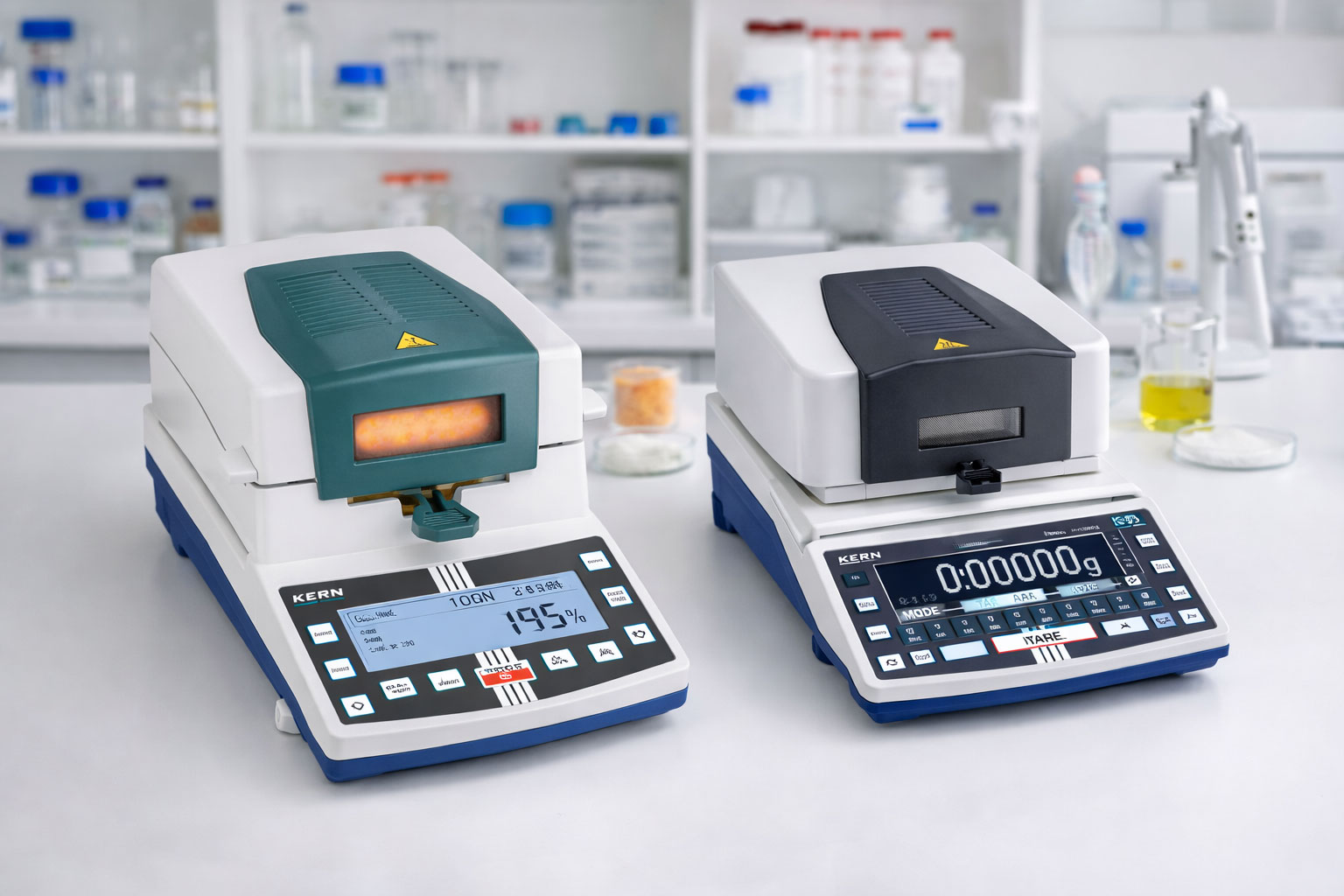
Moisture analyzers, also known as moisture balances, moisture determination balances or moisture meters, are essential instruments for determining the moisture content and dry matter of samples in laboratories, industrial production and quality assurance.
By combining a precision weighing system with controlled heating technology, modern moisture analyzers enable rapid, reproducible moisture determination without the lengthy procedures associated with conventional laboratory drying ovens.
At SMI, our range of professional moisture analyzers places particular emphasis on the proven weighing technology of KERN and Precisa. Both manufacturers offer solutions for moisture analysis, ranging from routine laboratory testing and incoming goods inspection to demanding industrial quality control applications.
Whether you need to determine moisture in powders, granules, food ingredients, chemicals, plastics, pharmaceutical raw materials or environmental samples, selecting the appropriate moisture analyzer helps improve process consistency, product quality and measurement efficiency.
A moisture analyzer is a laboratory or industrial measuring instrument that determines the moisture content of a sample by measuring its mass before and during a controlled drying process.
Most professional moisture analyzers operate according to the thermogravimetric loss-on-drying principle.
The instrument combines three essential components:
Precision weighing system: Continuously measures the sample mass during drying.
Integrated heating unit: Heats the sample under controlled conditions to remove moisture and other volatile substances.
Evaluation electronics: Calculate and display moisture content, dry matter or mass loss according to the selected measurement method.
Unlike a conventional laboratory balance, a moisture analyzer performs both weighing and drying within a single instrument.
This integrated process enables faster results, standardized testing procedures and efficient routine moisture determination.
The operating principle is based on measuring the loss of sample mass during heating.
First, a representative sample is placed on a sample pan and weighed.
The analyzer then heats the material according to a predefined drying program. As moisture and potentially other volatile substances evaporate, the sample mass decreases.
The weighing system continuously monitors this reduction until the selected drying endpoint is reached.
The instrument calculates the result using the initial and final sample masses.
For the commonly used wet-basis moisture calculation:
Moisture content (%) = [(Initial mass − Dry mass) / Initial mass] × 100
For example:
Initial sample mass: 10.000 g
Mass after drying: 8.500 g
Mass loss: 1.500 g
Calculated moisture content: 15.00%
The result indicates a mass loss of 15% relative to the initial sample mass.
Important: Loss-on-drying measures total mass loss under the selected conditions. If the sample contains solvents or other volatile compounds, the result may not represent water content exclusively.
For applications requiring water-specific determination, a method such as Karl Fischer titration may be more appropriate.
KERN is an established manufacturer of professional weighing equipment, offering moisture analyzers designed for laboratory work, industrial testing and quality control.
KERN moisture analyzers are particularly suitable for organizations seeking a practical combination of measurement performance, straightforward operation and cost-effective laboratory equipment.
Depending on the model, the range provides functions such as programmable drying temperatures, selectable drying programs, automatic switch-off criteria and digital result evaluation.
The KERN DAB series is designed for routine moisture determination in laboratories and industrial environments.
It is suitable for applications such as:
Incoming goods inspection
Quality control of raw materials
Moisture testing of powders and granules
Production monitoring
Routine laboratory measurements
Its straightforward operating concept makes it an interesting choice for businesses performing regular moisture tests without requiring extensive method-management functions.
The KERN DLB series provides another option for professional moisture testing.
It is suited to laboratories and industrial departments that need repeatable moisture determination using defined drying parameters.
Typical applications include testing raw materials, monitoring production samples and checking moisture levels in processed products.
The KERN DBS series addresses users requiring more extensive drying-program control and evaluation options.
Depending on the configuration, its functions support the development and repeated use of drying procedures for different sample materials.
This makes it relevant to quality control laboratories and production facilities working with multiple sample types.
KERN moisture analyzers are particularly attractive for:
Routine laboratory moisture testing
Small and medium-sized production facilities
Incoming goods inspection
Industrial quality assurance
Educational and research laboratories
Companies seeking practical and economical measuring equipment
The individual KERN series differ in weighing capacity, readability, heating technology, drying programs and available interfaces. These specifications should always be compared at model level.
Precisa is a Swiss manufacturer recognized for precision weighing technology and professional laboratory instruments.
Precisa moisture analyzers are designed for users who place particular importance on measurement performance, reproducibility, controlled drying procedures and reliable operation in demanding laboratory environments.
They are particularly relevant where moisture determination forms an integral part of established quality assurance or laboratory testing procedures.
A key aspect of professional moisture analysis is the interaction between weighing performance and the drying process.
Precisa instruments combine precision weighing technology with controlled heating systems to support consistent measurement conditions.
Depending on the model, advanced functions may include:
Configurable drying methods
Different heating profiles
Selectable measurement endpoints
Method storage
Result documentation
Interfaces for data transfer
Extended evaluation and reporting options
These capabilities can be especially valuable when laboratories analyze different materials or require standardized testing procedures.
Precisa moisture analyzers are particularly relevant for:
Laboratory quality control
Research and development
Pharmaceutical raw material testing
Chemical industry applications
Food production
Polymer and plastics testing
Materials research
Repeated analysis using validated internal methods
For users working with demanding samples, selecting the appropriate Precisa model and establishing suitable drying parameters are essential to obtaining meaningful results.
Both manufacturers offer professional instruments for thermogravimetric moisture determination, but they can address different purchasing priorities.
| Selection criteria | KERN | Precisa |
|---|---|---|
| Main positioning | Practical laboratory and industrial moisture analysis | Precision-oriented professional moisture analysis |
| Typical users | Routine laboratories, production and quality control | Laboratories, R&D and demanding quality assurance |
| Operating concept | From straightforward routine testing to advanced models | Model-dependent advanced method and evaluation functions |
| Drying programs | Depending on series | Depending on series |
| Data interfaces | Depending on model | Depending on model |
| Best selection approach | Match features and budget to testing requirements | Match method control and measurement performance to laboratory requirements |
KERN is an excellent starting point for businesses looking for practical, reliable moisture determination across a variety of routine applications.
Precisa deserves particular consideration when laboratories require sophisticated method control, precision weighing performance and detailed measurement documentation.
Neither manufacturer is automatically superior for every sample. The most suitable instrument depends on the required method, sample characteristics, measurement performance and documentation requirements.
Halogen heating is widely used in modern moisture analyzers because it provides rapid heat generation and responsive temperature control.
Its advantages can include:
Short heating times
Efficient routine analysis
Controlled drying temperatures
Good suitability for many powders, granules and solid materials
Compact instrument construction
Halogen heating is particularly useful where rapid moisture determination is required.
Some moisture analyzers use alternative infrared or radiant heating technologies.
The suitability of a heating system depends on the sample material, its thermal properties and the required drying conditions.
It is important not to assume that every KERN or Precisa moisture analyzer uses the same heating technology. The heating principle must be verified for the individual model.
Moisture content is an important quality parameter in many food products.
Moisture analyzers can be used to test:
Flour and grain products
Spices and seasonings
Coffee and tea
Dairy powders
Food ingredients
Dried fruit and vegetable products
Processed food samples
Moisture determination helps manufacturers monitor product consistency, processing conditions and storage characteristics.
In pharmaceutical development and manufacturing, moisture can influence the processing and stability of raw materials and finished products.
Moisture analyzers may be used for preliminary testing, process monitoring and quality control where the method is appropriate.
For regulated applications, instrument suitability, method validation, documentation and applicable quality requirements must be assessed separately.
Moisture analysis is used in the chemical industry to evaluate raw materials, powders, granules and processed substances.
Controlled moisture levels can be important for production consistency, handling characteristics and product specifications.
Special attention must be paid to materials that release volatile chemicals or decompose when heated.
Moisture can influence the processing behavior and quality of certain polymers.
Moisture analyzers may support testing of plastic granules and raw materials, provided the selected method is suitable for the material and required moisture range.
For very low moisture levels or applications requiring water-specific measurement, specialized methods may be necessary.
Moisture analyzers are also useful for environmental samples and wastewater treatment applications.
Typical samples include:
Sewage sludge
Wastewater treatment residues
Soil samples
Sediments
Filter cakes
Industrial waste materials
In these applications, moisture determination can help assess dry matter content, processing conditions and material characteristics.
For sewage sludge and similar materials, the drying procedure must be appropriate for the applicable laboratory method.
Moisture analyzers can be used to examine agricultural materials, feed ingredients and processed plant products.
Typical applications include the testing of grains, seeds, animal feed and agricultural raw materials.
Moisture determination may be relevant for construction-related materials such as powders, mineral samples and processed building products.
Sample preparation and drying conditions must be adapted to the material, particularly where chemically bound water or thermal decomposition may affect the result.
Moisture analyzers can provide different result formats depending on the instrument and selected calculation mode.
| Measurement | Meaning |
|---|---|
| Moisture content (% wet basis) | Mass lost during drying relative to the initial sample mass |
| Dry matter (% wet basis) | Remaining dry mass relative to the initial sample mass |
| Moisture content (% dry basis) | Mass lost during drying relative to the final dry mass |
| Residual mass (g) | Mass remaining after the drying process |
| Mass loss (g) | Difference between initial and final sample mass |
For wet-basis results, moisture percentage and dry matter percentage normally add up to 100%.
For example, a sample with 18% moisture content contains 82% dry matter on the same wet-basis calculation.
The selected reporting convention should always be consistent with the applicable testing method.
The maximum weighing capacity determines the amount of sample that can be placed on the instrument.
A higher capacity may be useful for larger or less homogeneous samples, but it does not automatically provide better moisture measurement performance.
The balance readability influences how precisely changes in sample mass can be detected.
Moisture resolution depends on the weighing system, sample mass and instrument calculation.
For applications involving very small moisture changes, careful evaluation of these factors is essential.
Different materials require different drying temperatures.
The available temperature range should be suitable for the sample and the method.
Excessively high temperatures may cause decomposition, oxidation or the evaporation of substances other than water.
Halogen and other radiant heating systems differ in their heating behavior.
The choice should reflect the material, desired analysis time and required method performance.
Advanced moisture analyzers may offer multiple drying profiles and endpoint criteria.
These functions can help optimize measurements for samples with different thermal characteristics.
For laboratories analyzing several sample types, the ability to store drying methods can improve consistency and reduce setup time.
Depending on the model, interfaces such as RS-232, USB or network connectivity may be available.
They can support result transfer, printing and integration with compatible laboratory systems.
Regular checks of the weighing system and drying temperature help maintain confidence in measurement performance.
Where appropriate, calibration services and reference materials can support laboratory quality assurance.
Even a high-quality moisture analyzer cannot compensate for unsuitable sample preparation.
For meaningful results, the sample should be representative of the material being tested.
Important considerations include:
Use a representative sample quantity.
Distribute the sample evenly across the pan.
Avoid excessively thick sample layers.
Select a suitable drying temperature.
Use appropriate drying endpoint criteria.
Prevent sample contamination.
Follow the same procedure for repeated measurements.
Document the method when traceability is required.
For samples that form a surface crust, melt, foam or release volatile compounds, special preparation techniques or alternative analytical methods may be necessary.
Both moisture analyzers and laboratory drying ovens can be used in gravimetric drying procedures, but they differ in operation and workflow.
| Feature | Moisture analyzer | Laboratory drying oven |
|---|---|---|
| Weighing and drying | Integrated in one instrument | Usually separate steps |
| Measurement time | Often faster for suitable samples | Frequently longer |
| Sample throughput | Typically individual samples | Multiple samples possible |
| Real-time mass monitoring | Yes | Usually not integrated |
| Method automation | Depending on model | Depends on equipment and workflow |
| Reference method suitability | Requires method validation or comparison | Often used in standardized reference procedures |
A moisture analyzer can significantly improve routine testing efficiency, but it should not automatically be treated as interchangeable with a specified reference drying-oven method.
Where compliance with a standard is required, the selected procedure must be demonstrated to meet that standard.
Reliable moisture determination depends on both the weighing system and the heating process.
Routine quality assurance may include:
Balance calibration or performance checks
Temperature verification
Repeatability testing
Testing with suitable reference materials
Comparison with an established reference method
Documentation of drying programs
Regular cleaning and maintenance
The required frequency depends on the application, the instrument, the laboratory's quality system and the consequences of an incorrect result.
A moisture analyzer is used to determine the mass lost by a sample during controlled drying. It is commonly used for moisture testing, dry matter determination and quality control in laboratories and industry.
A moisture analyzer typically determines moisture by measuring mass loss during heating. Other moisture meters may use electrical, capacitive, infrared spectroscopic or other measurement principles. The terms are sometimes used interchangeably, but the technologies can differ significantly.
Yes. KERN offers moisture analyzers suitable for routine laboratory testing and various industrial quality control applications. The correct model depends on the material and measurement requirements.
Yes. Precisa offers professional moisture determination instruments for laboratory and industrial applications, including situations where reproducibility and controlled drying methods are important.
Both manufacturers offer professional solutions. KERN is particularly attractive for practical routine testing, while Precisa is worth considering for applications requiring more extensive method control and laboratory-oriented functionality. The final decision should be based on specific model characteristics.
Yes. Many moisture analyzers can display dry matter as a percentage of the initial sample mass, in addition to moisture content.
Yes, when the instrument and drying method are appropriate. Moisture and dry matter determination are relevant to wastewater treatment and environmental laboratory applications.
The measurement time depends on sample mass, moisture content, drying temperature, material properties and endpoint criteria. Some routine tests take only a few minutes, while other materials require longer drying periods.
Not necessarily. Thermogravimetric moisture analyzers measure mass loss during drying, which may include water and other volatile substances.
Regular checks of the weighing system and drying temperature are recommended. The required calibration and verification procedures depend on the application and the laboratory's quality requirements.
At SMI, laboratories, manufacturers, research institutions and quality control departments can find professional moisture analyzers for a wide range of applications.
Our product selection places particular emphasis on KERN and Precisa, two established manufacturers of precision weighing and moisture determination equipment.
Whether you require a practical moisture balance for routine production testing, a professional analyzer for quality assurance or an advanced instrument for laboratory method development, the right solution depends on your samples, measurement requirements and working environment.
Explore our range of KERN and Precisa moisture analyzers and select the instrument that best matches your requirements for weighing performance, heating technology, drying programs and result documentation.


