
- -10%

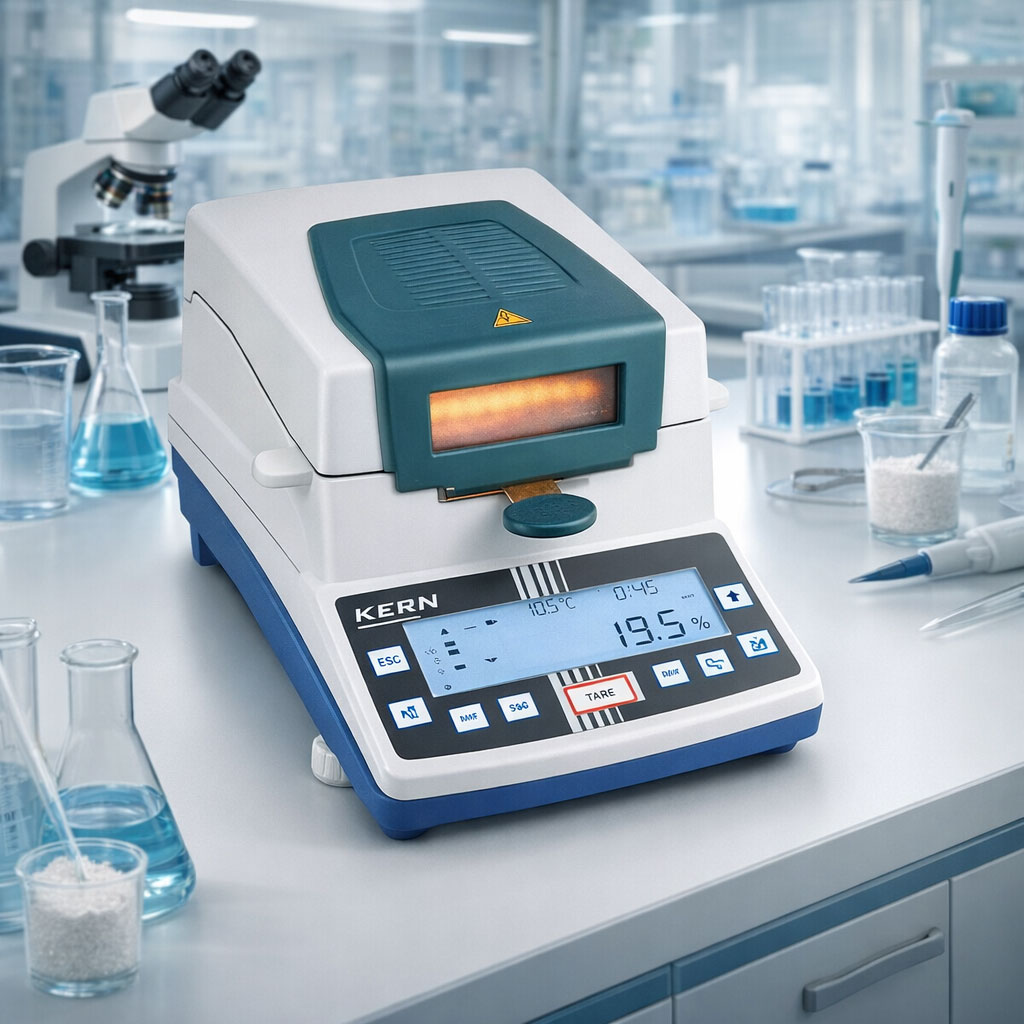
The KERN DAB moisture analyzers combine precision weighing technology with controlled thermal drying to deliver efficient moisture and dry matter determination for laboratory and industrial applications.
Available with halogen or infrared quartz-glass heating technology, the DAB series provides a practical solution for routine moisture testing, incoming goods inspection, production monitoring and material quality control.
With four model variants, two weighing capacities, three selectable drying profiles and a clear graphical display, KERN DAB moisture analyzers allow users to choose the appropriate combination of heating technology, weighing resolution and sample capacity.
The range includes the KERN DAB 100-3, DAB 200-2, DAB 100-3IR and DAB 200-2IR.
Whether testing food ingredients, agricultural materials, industrial powders, granules or suitable environmental samples, the KERN DAB series supports repeatable moisture determination using defined drying parameters.
The DAB family is designed for users who require straightforward operation without sacrificing essential functions for professional moisture analysis.
The series offers two different heating systems:
Halogen heating: DAB 100-3 and DAB 200-2, with a temperature range of 40–199 °C.
Infrared heating: DAB 100-3IR and DAB 200-2IR, with a temperature range of 40–160 °C.
Each heating technology is available with a choice of two weighing capacities:
110 g capacity with 0.001 g readability for finer detection of mass changes.
200 g capacity with 0.01 g readability for larger sample quantities and routine testing.
This combination allows laboratories to select a model based on their samples, required weighing resolution and drying temperature.
KERN DAB analyzers operate according to the thermogravimetric loss-on-drying principle.
A representative sample is placed on a sample pan and weighed using the integrated balance.
The heating system then raises the sample temperature according to the selected drying program.
As water and potentially other volatile substances evaporate, the sample mass decreases. The instrument monitors this change and calculates the measurement result.
The typical moisture calculation is:
Moisture (%) = [(Initial sample mass − Final dry mass) / Initial sample mass] × 100
For example, a sample weighing 10.000 g before drying and 8.500 g afterwards shows a mass loss of 15.00%.
Depending on the selected result mode, the instrument can display moisture content, dry matter or sample mass.
Thermogravimetric moisture analysis measures the total mass lost under the selected drying conditions.
If the material contains solvents or other volatile substances, these may contribute to the measured loss.
Similarly, chemical decomposition or oxidation can affect the result.
For applications requiring water-specific determination, a different analytical technique may be necessary.
The KERN DAB 100-3 and DAB 200-2 feature a 400 W halogen quartz-glass heater.
Halogen heating provides rapid heat generation and enables controlled drying within the adjustable temperature range of 40–199 °C.
The temperature can be selected in 1 °C increments.
This makes the halogen versions particularly interesting for applications that require flexible temperature settings and efficient routine measurements.
Typical sample materials may include:
Food powders and ingredients
Grain and agricultural materials
Industrial powders
Granules
Selected chemical raw materials
Suitable plastics and polymer samples
Environmental materials
The drying temperature must always be adapted to the thermal properties of the sample.
The DAB 100-3 provides a maximum weighing capacity of 110 g and a readability of 0.001 g.
Its moisture display readability is 0.01%.
This model is particularly attractive when detecting relatively small changes in sample mass is important.
It is suitable for laboratories and quality control departments requiring finer mass resolution within the DAB range.
The DAB 200-2 offers a maximum weighing capacity of 200 g with a readability of 0.01 g.
Its moisture display readability is 0.05%.
The greater weighing capacity is useful when testing larger sample quantities.
KERN also positions this version for quick tests and spot checks, where the lower resolution can allow the selected switch-off criterion to be reached sooner.
The DAB series also includes two dedicated infrared moisture analyzers:
KERN DAB 100-3IR
KERN DAB 200-2IR
These models use a 400 W infrared quartz-glass heater instead of the halogen heating system fitted to the standard DAB versions.
Their adjustable temperature range is 40–160 °C, in increments of 1 °C.
The infrared versions retain the familiar DAB operating concept while providing an alternative heating technology for suitable laboratory and industrial applications.
Importantly, infrared heating should not automatically be regarded as gentler or more accurate than halogen heating. Measurement performance depends on the sample material, drying conditions and validated method.
The DAB 100-3IR combines infrared heating with a maximum weighing capacity of 110 g.
Its weighing readability is 0.001 g, while moisture results can be displayed with a resolution of 0.01%.
This makes it an interesting choice for users who require the infrared heating version and finer mass resolution.
The temperature range of 40–160 °C supports controlled drying of suitable materials.
The DAB 200-2IR offers a maximum weighing capacity of 200 g and a readability of 0.01 g.
Its moisture display readability is 0.05%.
This model is particularly suitable for users prioritizing larger sample quantities and efficient routine measurements with infrared heating.
Like the DAB 100-3IR, it operates within a temperature range of 40–160 °C.
| Specification | DAB 100-3 | DAB 200-2 | DAB 100-3IR | DAB 200-2IR |
|---|---|---|---|---|
| Heating technology | Halogen | Halogen | Infrared | Infrared |
| Heating power | 400 W | 400 W | 400 W | 400 W |
| Maximum capacity | 110 g | 200 g | 110 g | 200 g |
| Weighing readability | 0.001 g | 0.01 g | 0.001 g | 0.01 g |
| Moisture readability | 0.01% | 0.05% | 0.01% | 0.05% |
| Temperature range | 40–199 °C | 40–199 °C | 40–160 °C | 40–160 °C |
| Temperature increments | 1 °C | 1 °C | 1 °C | 1 °C |
| Drying profiles | 3 | 3 | 3 | 3 |
| Switch-off modes | Automatic, timed, manual | Automatic, timed, manual | Automatic, timed, manual | Automatic, timed, manual |
Choose the DAB 100-3 when fine mass resolution and the wider halogen temperature range are important.
Choose the DAB 200-2 when larger sample quantities and straightforward halogen-based routine testing are the priority.
Choose the DAB 100-3IR when infrared heating and finer mass resolution are required.
Choose the DAB 200-2IR when infrared heating is preferred and a higher weighing capacity is beneficial.
The final selection should always consider the material, required sample quantity, drying temperature and acceptable measurement uncertainty.
Standard drying provides a straightforward heating profile for many routine measurements.
It is a useful starting point when developing a moisture determination procedure for a new sample material.
Rapid drying is intended for suitable materials that tolerate accelerated heating.
It may help shorten measurement time when the sample characteristics and method permit.
Gentle drying provides a more gradual heating process.
It can be useful when rapid heating would adversely affect the sample or the quality of the measurement.
However, a gentle drying profile does not guarantee that a heat-sensitive material can be analyzed without decomposition.
The analyzer can terminate drying automatically when the defined mass-loss criterion is reached.
This supports repeatable routine measurements without requiring the operator to determine the endpoint manually.
A defined drying duration can be selected for procedures requiring a fixed measurement time.
This is useful when following established internal testing methods.
The drying process can also be stopped manually.
This option can be helpful during method development, exploratory testing and sample evaluation.
KERN DAB moisture analyzers feature a backlit graphical display with a digit height of 14 mm.
The display provides important information during measurement, including:
Active drying process
Selected heating profile
Active switch-off criterion
Elapsed drying time
Current temperature
Current moisture content
This allows operators to monitor the progress of the analysis and verify the selected settings.
The straightforward interface makes the DAB series especially suitable for regular testing in laboratories and industrial quality control departments.
The DAB series provides internal storage for 15 complete drying programs and five completed drying processes.
Stored drying programs allow users to recall previously defined parameters for recurring measurements.
This is especially useful when analyzing several materials that require different drying conditions.
For example, separate programs may be established for:
Food ingredients
Agricultural materials
Industrial powders
Granules
Production samples
Method storage reduces repetitive setup and supports more consistent laboratory workflows.
The KERN DAB series includes an observation window above the sample.
This allows the operator to visually monitor the material during drying.
It is particularly useful when establishing a method for the first time.
Potential changes such as discoloration, foaming, melting or surface crust formation may indicate that the drying temperature or heating profile needs adjustment.
Visual observation is an important practical aid, although it does not replace formal method validation.
The DAB family provides an RS-232 interface for connection to compatible peripheral equipment.
Depending on the connected system, measurement data can be transferred to a computer or printer.
This can support:
Laboratory result documentation
Printing measurement records
Quality control reporting
Evaluation of repeated tests
Archiving measurement results
Compatibility with existing software and accessories should be verified before purchase.
Moisture content is a key quality parameter in food manufacturing.
KERN DAB analyzers can be used for suitable samples such as flour, grain products, spices, powdered ingredients, coffee, tea and processed food materials.
Regular testing can help monitor incoming ingredients and production consistency.
Agricultural materials often require moisture monitoring during processing and storage.
Typical applications include grain, seeds, animal feed and suitable plant-based materials.
Sample preparation is particularly important when testing heterogeneous materials.
Moisture can influence the processing behavior of certain polymers and plastic granules.
KERN DAB analyzers may be used for suitable routine tests, provided the method offers sufficient sensitivity and selectivity.
Very low residual moisture levels may require specialized analytical methods.
The DAB series can support the examination of powders, granules and other compatible chemical raw materials.
Materials containing volatile solvents or substances that decompose during heating require special assessment.
Moisture analyzers are useful for investigating suitable environmental materials such as sewage sludge, filter cakes, soil and sediments.
A common objective is the determination of dry matter content.
This information can support monitoring of dewatering processes and material treatment.
For standardized testing, the chosen method must meet the applicable requirements.
The DAB series can be integrated into routine material inspection procedures.
Stored drying programs and defined switch-off criteria support consistent testing of raw materials, intermediate products and finished goods.
Moisture analyzers can provide different result formats depending on the selected operating mode.
| Measurement | Meaning |
|---|---|
| Moisture content (%) | Mass lost during drying relative to the initial sample mass |
| Dry matter (%) | Remaining mass relative to the initial sample mass |
| Moisture mass (g) | Absolute mass lost during drying |
| Dry mass (g) | Mass remaining after drying |
For results calculated on a wet basis, moisture content and dry matter content add up to 100%.
For example, a sample with a moisture content of 18% contains 82% dry matter on the same calculation basis.
The most important difference between the DAB heating variants is the heating system and available temperature range.
The halogen versions are particularly interesting when:
A drying temperature above 160 °C is required.
The laboratory already uses a suitable halogen-based method.
A broader adjustable temperature range is important.
Routine measurements are performed on compatible materials.
The infrared versions are worth considering when:
The laboratory specifically requires an infrared quartz-glass heater.
The selected method operates within 40–160 °C.
The heating technology matches an existing laboratory procedure.
The required weighing capacity and resolution correspond to the IR models.
Neither heating system should be selected solely on the assumption that it always produces faster or more accurate results.
The appropriate method must be established for the material under investigation.
The quality of moisture determination depends on several factors:
Weighing performance
Heating temperature
Sample preparation
Drying profile
Switch-off criterion
Environmental conditions
Sample composition
Regular weighing checks and appropriate temperature verification help maintain confidence in measurement results.
Where required, suitable calibration certificates and performance checks can support laboratory quality assurance.
A mass calibration certificate and a temperature calibration or verification are separate services.
The sample should accurately represent the material being tested.
An even sample layer promotes more consistent heating.
Excessively high temperatures can cause decomposition, oxidation or other unwanted changes.
Standard, rapid and gentle drying profiles should be evaluated according to the sample properties.
Automatic, timed or manual switch-off should be selected according to the testing method.
For repeatable results, record the sample mass, temperature, heating profile and endpoint criteria.
The KERN DAB series is positioned as a practical solution for routine moisture determination.
It offers four variants, including halogen and infrared heating, together with essential functions such as programmable drying profiles, method storage and a graphical display.
The KERN DLB series is another option for professional moisture analysis, with a different operating concept and model-dependent features.
The KERN DBS series is relevant to laboratories requiring additional method and documentation capabilities.
When comparing these families, evaluate the exact specifications rather than assuming that a higher-priced or more advanced series is automatically better for every sample.
The KERN DAB is a professional thermogravimetric moisture analyzer combining precision weighing and controlled sample heating.
The range includes DAB 100-3, DAB 200-2, DAB 100-3IR and DAB 200-2IR.
Standard DAB models use halogen quartz-glass heating with a temperature range of 40–199 °C. DAB IR models use infrared quartz-glass heating with a range of 40–160 °C.
The 100-3 versions offer 110 g capacity with 0.001 g readability. The 200-2 versions offer 200 g capacity with 0.01 g readability.
Not inherently. Accuracy depends on the weighing system, sample properties, drying method and measurement conditions.
Yes. The DAB series can display dry matter as well as moisture content.
The series provides standard, rapid and gentle drying profiles.
Yes. The instruments provide memory for 15 drying programs.
Yes. The RS-232 interface supports connection to compatible equipment.
They can be used for suitable sludge samples and dry matter determination when the drying method is appropriate.
No. The thermogravimetric method measures total mass loss, which may include volatile substances other than water.
The best model depends on sample mass, required readability, heating technology and drying temperature. The 200-2 variants are particularly interesting for larger sample quantities and routine spot checks.
At SMI, laboratories, industrial manufacturers and quality control departments can find KERN DAB moisture analyzers for professional moisture and dry matter determination.
Choose from four configurations:
KERN DAB 100-3: Halogen heating, 110 g capacity, 0.001 g readability.
KERN DAB 200-2: Halogen heating, 200 g capacity, 0.01 g readability.
KERN DAB 100-3IR: Infrared heating, 110 g capacity, 0.001 g readability.
KERN DAB 200-2IR: Infrared heating, 200 g capacity, 0.01 g readability.
Whether your priority is fine mass resolution, higher sample capacity or a specific heating technology, the KERN DAB family offers flexible solutions for routine laboratory and industrial moisture testing.
Explore our selection of KERN DAB halogen and infrared moisture analyzers and choose the instrument that matches your samples, testing procedures and quality control requirements.


