
- -10%

SAUTER AFH 04 Stainless steel handle bar for force gauge
€94.50
€105.00
Rated out of 5 stars based on review(s)
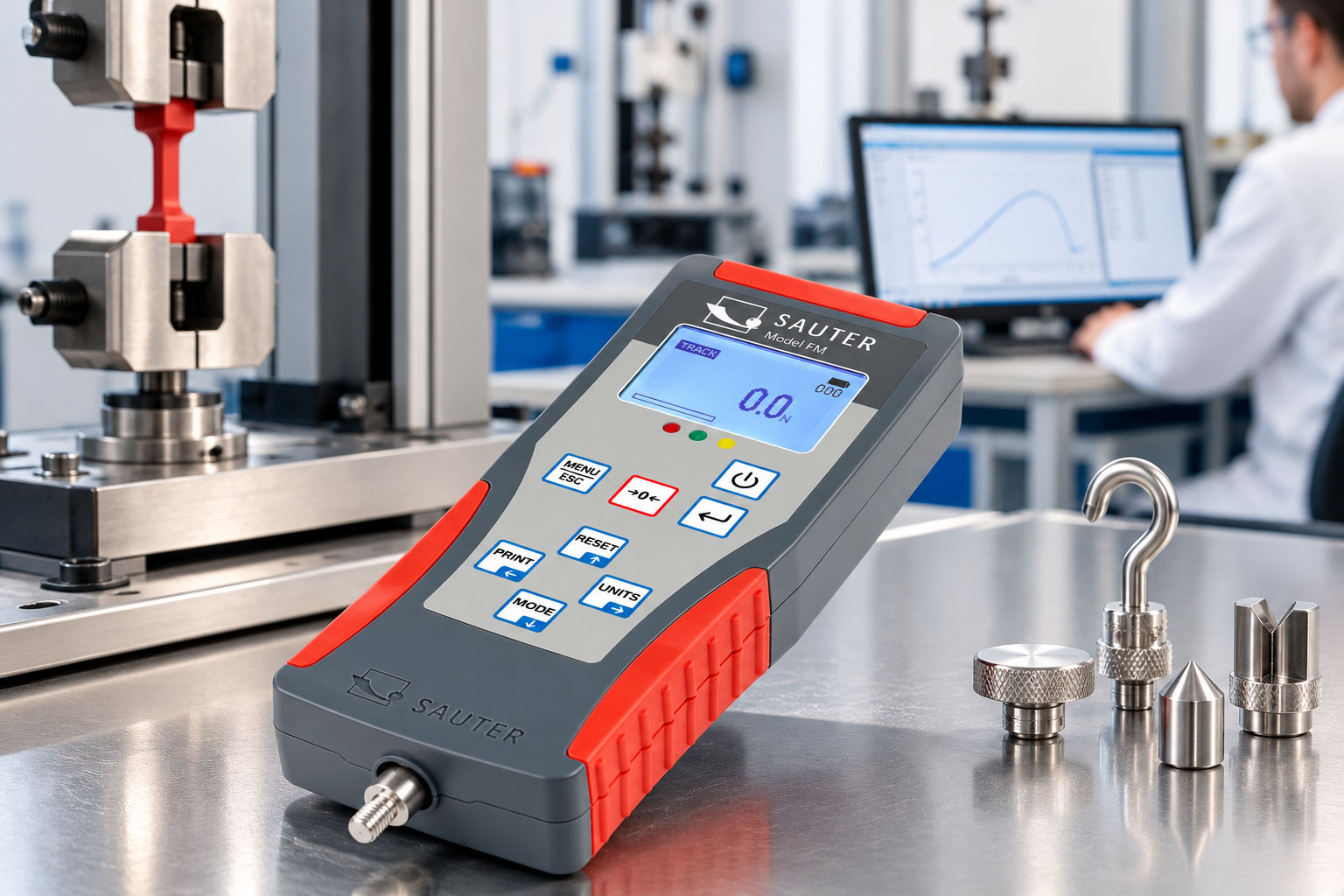
The SAUTER FM digital force gauge series provides a professional solution for measuring tensile and compressive forces in industrial quality control, mechanical testing and engineering laboratories.
In modern manufacturing, force measurement plays an essential role in verifying component performance, evaluating mechanical assemblies and maintaining consistent product quality.
The force required to extract a connector, operate a switch, compress a spring or release a mechanical fastening system can determine whether a component meets its specified performance requirements.
SAUTER FM instruments are designed to support these demanding applications with digital force measurement, practical testing functions and integrated data management capabilities.
The series comprises 13 model variants with maximum capacities ranging from 5 N to 20 kN, providing solutions for low-force component testing as well as higher-load industrial applications.
Models with an integrated load cell offer a compact configuration for handheld operation and compatible test stand mounting. Versions with an external load cell allow the force sensor to be positioned separately from the display unit, making them particularly suitable for higher capacities and specialised mechanical test setups.
With a 1,000 Hz measurement frequency, a manufacturer-specified measurement tolerance of 0.2% of full scale, Peak Hold functionality and continuous Track mode, the FM series supports a broad range of professional force-testing procedures.
An internal memory for up to 500 measurement values and USB-C and PS/2 interfaces provide additional options for storing and transferring results.
The backlit, reversible display, graphical capacity indicator and programmable tolerance limits further enhance usability in production environments and technical laboratories.
Whether used for component inspection, product development, assembly verification or mechanical quality assurance, SAUTER FM digital force gauges combine precise measurement capabilities with flexible integration options.
Tension and compression measurement: Measure pulling and pushing forces with one system
13 model variants: Maximum capacities from 5 N to 20,000 N
Integrated or external load cells: Choose the configuration best suited to the testing application
0.2% full-scale measurement tolerance: Manufacturer-specified performance for technical inspection
1,000 Hz measurement frequency: Fast acquisition of changing forces
Peak Hold function: Capture maximum measured force values
Track mode: Continuously display the applied force
Programmable tolerance limits: Check measurements against defined acceptance criteria
Visual indication: Support efficient evaluation of test results
Internal measurement memory: Store up to 500 readings
USB-C interface: Transfer measurement data to compatible systems
PS/2 interface: Additional connectivity for supported equipment
Backlit LCD display: Clear readings under different lighting conditions
Reversible display orientation: Convenient viewing in different operating positions
Graphical capacity indicator: Monitor the utilisation of the available measuring range
Rechargeable battery operation: Flexible use at different workstations
Test stand compatibility: Integration with suitable SAUTER force test stands
Calibration options: Support professional measurement traceability
The SAUTER FM range is divided into two principal configurations: digital force gauges with integrated load cells and instruments with external load cells.
In these models, the force sensor is integrated into the instrument housing.
Their compact design makes them suitable for handheld force measurement and installation on compatible test stands.
| Model | Maximum force capacity | Display resolution |
|---|---|---|
| SAUTER FM 5 | 5 N | 0.002 N |
| SAUTER FM 10 | 10 N | 0.005 N |
| SAUTER FM 20 | 20 N | 0.01 N |
| SAUTER FM 50 | 50 N | 0.02 N |
| SAUTER FM 100 | 100 N | 0.05 N |
| SAUTER FM 200 | 200 N | 0.1 N |
| SAUTER FM 500 | 500 N | 0.2 N |
| SAUTER FM 1K | 1,000 N | 0.5 N |
External load cell models feature a separate force sensor connected to the display unit.
This design provides additional flexibility when the sensor must be integrated into a mechanical testing arrangement.
| Model | Maximum force capacity | Display resolution |
|---|---|---|
| SAUTER FM 1K EXT | 1,000 N | 0.5 N |
| SAUTER FM 3K | 3,000 N | 1 N |
| SAUTER FM 5K | 5,000 N | 2 N |
| SAUTER FM 10K | 10,000 N | 5 N |
| SAUTER FM 20K | 20,000 N | 10 N |
The manufacturer specifies a measurement tolerance of 0.2% of the maximum measuring capacity.
Display resolution and measurement accuracy are different technical characteristics and should not be treated as equivalent.
SAUTER FM models with integrated load cells combine the measuring sensor and display in one housing.
This arrangement is particularly convenient for manual inspection tasks and compact testing stations.
Force is applied through suitable attachments connected to the instrument's measuring axis.
Push-button actuation force measurement
Mechanical switch testing
Connector extraction testing
Spring force verification
Plastic component inspection
Mechanical closure testing
Product development
Routine industrial quality control
The integrated models are equipped with an M6 external thread for compatible measuring attachments.
Compact construction
Convenient handheld operation
Straightforward installation in compatible test stands
Direct display of measured forces
Suitable for mobile inspection tasks
Practical for repetitive component testing
The correct capacity should be selected according to the expected maximum force and the required display resolution.
The SAUTER FM external load cell models are designed for applications in which the force sensor must be positioned independently of the display unit.
This configuration is particularly valuable when testing larger components, working with higher forces or integrating the measuring system into a suitable mechanical fixture.
External load cells are available with maximum capacities from 1 kN to 20 kN.
Pull-out force testing
Mechanical connection inspection
Retention force measurement
Compression testing of industrial components
Load testing of suitable assemblies
Evaluation of fastening systems
Mechanical engineering experiments
Integration into custom test fixtures
The load cell must be mounted correctly and loaded along its intended measurement axis.
Separate positioning of sensor and display
Greater flexibility in mechanical test arrangements
Higher available force capacities
Easier integration into suitable fixtures
Reduced need to handle the measuring instrument directly
Adaptability to different testing geometries
The load cell, mounting components and accessories must all be rated for the expected forces.
Both models offer a maximum measuring capacity of 1,000 N and a display resolution of 0.5 N.
Their primary difference is the location of the force sensor.
SAUTER FM 1K: Integrated load cell in a compact handheld instrument.
SAUTER FM 1K EXT: External load cell connected to a separate display unit.
The integrated version is particularly suitable for direct measurements and compact test stand applications.
The external version is advantageous when the sensor needs to be installed within a dedicated testing fixture.
The decision should therefore be based on the mechanical arrangement rather than the force capacity alone.
Tensile force testing measures the force applied when a component is pulled, stretched or separated.
It is widely used in industrial inspection because many mechanical connections must withstand specified pulling forces.
The SAUTER FM series supports tensile force measurements across a wide range of capacities.
Electrical and mechanical connectors often require defined insertion and extraction characteristics.
A connection with insufficient retention force may separate unintentionally.
An excessively high extraction force may make servicing or assembly difficult.
A digital force gauge can measure the force required to separate a connector under defined test conditions.
Suitable cable assemblies and fastening systems can be tested to determine the force necessary to pull a cable or connected element from its fixture.
Appropriate grips and alignment are essential for meaningful results.
The tensile force of an extension spring can be measured at a defined extension.
For repeatable results, the spring displacement and testing procedure should remain consistent.
The force required to release or open a mechanical closure can be evaluated using a suitable force gauge and fixture.
This is relevant for product development and industrial component inspection.
Plastic clips and snap-fit assemblies can be tested to determine their separation or release forces.
Such measurements help engineers compare component designs and manufacturing conditions.
Compression testing measures forces applied when a component is pushed, compressed or mechanically loaded.
SAUTER FM digital force gauges support a broad range of compression testing applications.
The force required to operate a push button can affect both functional reliability and user experience.
Measuring this force helps verify whether a component meets the intended specification.
Compression springs can be tested at defined displacement positions.
A suitable test stand is recommended when consistent loading conditions are important.
Components and assemblies can be evaluated under controlled compression loads.
The test may focus on actuation force, mechanical resistance or another specified performance characteristic.
Plastic parts can be subjected to controlled compression to evaluate their mechanical behaviour.
Suitable contact attachments and fixtures help distribute the load correctly.
In many industrial applications, the highest force reached during a test is the most important result.
The Peak Hold function captures and displays the maximum registered force.
This makes it particularly useful for applications involving short force peaks.
Connector extraction force
Mechanical latch release force
Maximum spring compression force
Push-button actuation force
Retention force testing
Pull-off force inspection
Maximum load comparison
A connector is secured in a suitable testing fixture.
A pulling force is applied until the connection begins to separate.
During the test, the measured force increases and changes.
The Peak Hold function captures the highest recorded value.
This result can then be compared with the specified acceptance criterion.
The reliability of peak capture depends on the measuring system and the dynamics of the testing procedure.
In Track mode, the SAUTER FM displays the current force continuously.
This enables operators to monitor changing loads while a specimen is pulled, compressed or actuated.
Track mode is useful for spring testing, component evaluation and engineering experiments.
It provides immediate feedback about the applied force.
However, continuous force display does not automatically mean that a complete force-time or force-displacement curve is recorded.
The SAUTER FM series operates with a measurement frequency of 1,000 Hz.
This corresponds to an internal acquisition frequency of 1,000 measurements per second.
Fast measurement acquisition is valuable in applications where forces change over short time intervals.
Mechanical switch actuation
Connector release testing
Snap-fit mechanism inspection
Short-duration peak force measurements
Mechanical breakaway testing
Functional component inspection
The internal measurement frequency should not be confused with the data transmission rate to an external computer.
A major advantage of the SAUTER FM series is its integrated measurement memory.
The instrument can store up to 500 measurement values.
This feature is particularly useful when multiple components must be tested in succession.
Instead of recording every value manually, operators can retain readings in the instrument for subsequent processing.
Store multiple measurement results
Support repetitive inspection procedures
Reduce manual transcription
Facilitate comparison of measured values
Prepare data for further evaluation
Improve efficiency at quality-control workstations
A manufacturer needs to verify the actuation force of a series of mechanical switches.
Each component is tested according to a defined procedure.
The resulting force values are stored in the instrument.
The readings can subsequently be reviewed or transferred for further evaluation.
Internal measurement storage does not, by itself, constitute a complete traceable inspection report.
Additional information such as specimen identification, test conditions and operator details may be required.
The SAUTER FM series includes a USB-C interface for data communication with compatible systems.
This enables force measurements to be used beyond the instrument's display.
Depending on the connected equipment and software, measurement values can be transferred for further processing.
Transfer readings to compatible computers
Support electronic inspection documentation
Compare measurement results
Process data in suitable software
Integrate force measurement into technical workstations
Assist with structured quality-control procedures
The internal measurement frequency is 1,000 Hz.
The documented data transmission rate to a PC is approximately 25 measurement values per second.
This distinction is important when planning data acquisition or automated testing systems.
The USB-C interface does not imply that every internally acquired measurement is transmitted individually at 1,000 Hz.
In addition to USB-C, SAUTER FM force gauges provide a PS/2 interface.
This expands the available options for connecting supported equipment.
Before integrating the instrument into a test stand or other measurement arrangement, the relevant interface specifications and compatibility requirements should be checked.
The SAUTER FM series supports upper and lower force limits for tension and compression measurements.
These limits allow operators to evaluate measured values against predefined requirements.
Visual indication assists with interpreting the results.
A manufacturer specifies an acceptable actuation force range for a mechanical push button.
During inspection, the force is measured using a SAUTER FM instrument.
The measured value is compared with the configured limits.
This helps identify components that fall outside the defined acceptance range.
Consistent inspection criteria
Faster evaluation of results
Support for repetitive testing
Reduced manual comparison
Clearer identification of deviations
More efficient quality-control workflows
Acceptance limits must be established according to the applicable product specification and testing method.
SAUTER FM force gauges feature a graphical capacity indicator.
This shows how much of the available measuring range is currently being used.
The indicator provides a quick visual reference alongside the numerical force reading.
It is particularly helpful when forces increase progressively during a test.
The capacity indicator does not replace the requirement to remain within the specified measuring range.
The SAUTER FM series features a backlit LCD display with graphical support.
The backlight improves readability in laboratories, workshops and production environments.
The reversible display orientation allows the measurement value to be viewed more conveniently when the instrument is used in different positions.
This is particularly useful for handheld testing and certain test stand configurations.
Manual force testing can be influenced by operator movement, loading speed and alignment.
A suitable force test stand helps establish more consistent conditions.
SAUTER FM models with integrated load cells can be mounted on compatible SAUTER test stands with capacities up to 5 kN.
The maximum capacity of the installed force gauge must always be respected, regardless of the test stand's higher load rating.
Improved axial loading
Reduced operator influence
More consistent test conditions
Better repeatability
Suitable specimen positioning
Compatibility with appropriate grips and fixtures
Manual test stands are suitable for applications requiring guided force application without motorised movement.
They can provide improved control compared with unrestricted handheld testing.
Motorised test stands may provide more consistent movement during suitable repetitive testing procedures.
The exact combination must be selected according to force capacity, mounting compatibility, travel requirements and test method.
Some applications require measurement of both applied force and specimen displacement.
A complete force-displacement curve requires suitable displacement measurement and data acquisition equipment.
The SAUTER FM force gauge alone should not be treated as a complete force-displacement testing system.
Many industrial components must operate within specified mechanical force limits.
A connector must provide sufficient retention force.
A push button must require an acceptable actuation force.
A mechanical latch must release under the intended conditions.
SAUTER FM force gauges support the measurement of these characteristics.
Connector extraction testing
Push-button actuation testing
Spring force verification
Mechanical closure inspection
Retention force measurement
Assembly force evaluation
Production batch comparison
Functional component testing
Internal data storage, tolerance checking and digital connectivity make the FM series particularly useful for structured inspection procedures.
Automotive manufacturing involves numerous components whose mechanical performance depends on defined forces.
SAUTER FM instruments can support suitable development and quality-control tests.
Electrical connector extraction
Switch actuation force
Mechanical latch testing
Retaining clip inspection
Spring-loaded mechanisms
Plastic snap-fit assemblies
Interior control components
Mechanical assembly verification
For safety-critical or standardised testing, the complete measurement system must meet the applicable requirements.
Plastic components frequently rely on clips, snap-fit mechanisms and mechanical fastening systems.
The forces required to engage, operate or release these connections can be important quality characteristics.
SAUTER FM force gauges can help evaluate these forces under defined conditions.
Snap-fit release force measurement
Plastic closure testing
Connector inspection
Mechanical resistance checks
Product design comparisons
Production quality control
Suitable grips and loading arrangements are essential to avoid misleading results or unintended damage to the specimen.
Mechanical engineering laboratories use force measurements to evaluate the performance of mechanisms, fasteners and structural components.
SAUTER FM instruments can support a range of testing applications within their specified capacities.
External load cell models are particularly useful when higher forces or specialised mechanical fixtures are involved.
Mechanical connection testing
Retention force measurement
Spring mechanism evaluation
Actuation force testing
Assembly inspection
Prototype comparison
Functional load testing
During product development, force measurement provides valuable information about how components respond to applied loads.
Engineers can use defined tests to compare different prototypes, investigate mechanical behaviour and evaluate design changes.
Prototype comparison
Spring force analysis
Mechanical actuation studies
Fastening system evaluation
Component resistance testing
Functional performance checks
Engineering experiments
The integrated memory and digital interfaces support further evaluation of measured results.
For advanced dynamic analysis, complete data logging or force-displacement recording, additional equipment may be required.
Portable force gauges can also be valuable for maintenance and technical service tasks.
They can be used to compare actuation forces, evaluate mechanical mechanisms or check components against established reference values.
Integrated load cell models are particularly convenient for mobile inspection tasks.
External load cell models may be integrated into suitable fixtures when higher loads or different installation arrangements are required.
| Specification | SAUTER FM |
|---|---|
| Measurement direction | Tension and compression |
| Maximum force capacities | 5 N to 20 kN |
| Number of model variants | 13 |
| Load cell configuration | Integrated or external |
| Measurement tolerance | 0.2% of full scale |
| Measurement frequency | 1,000 Hz |
| Overload protection | 120% of maximum capacity |
| Internal memory | Up to 500 measurement values |
| Measurement modes | Peak Hold and Track |
| Tolerance function | Configurable upper and lower limits |
| Interfaces | USB-C and PS/2 |
| Force units | N, kN, kgf, lbf |
| Display | Backlit, reversible LCD with graphical support |
| Capacity indicator | Graphical measurement range indication |
| Display unit housing | ABS plastic |
| Approximate display unit dimensions | 71 × 31 × 180 mm |
| Power supply | Rechargeable battery and compatible mains power |
| Test stand compatibility | Suitable SAUTER test stands, depending on model |
| Calibration | Suitable factory or accredited calibration options, depending on model |
Exact specifications, supplied accessories and compatibility requirements should be checked for the selected model.
The maximum capacity defines the highest force that can be measured within the specified operating range.
For example, the SAUTER FM 100 has a maximum capacity of 100 N.
Display resolution indicates the smallest force increment shown by the instrument.
For the FM 100, this is 0.05 N.
The manufacturer specifies a tolerance of 0.2% of full scale.
For a 100 N capacity instrument, 0.2% corresponds to 0.2 N.
This demonstrates why display resolution and measurement accuracy must not be confused.
When measuring relatively small forces, selecting an unnecessarily high-capacity instrument may reduce the usefulness of the available display resolution.
The correct model should cover the expected maximum load while providing suitable measurement performance.
The SAUTER FM series has a manufacturer-specified overload protection rating of 120% of maximum capacity.
This value must not be interpreted as an extension of the normal measuring range.
The rated maximum capacity must be respected during regular operation.
Select the appropriate force capacity
Apply loads along the intended measurement axis
Avoid lateral forces
Use compatible measuring attachments
Prevent excessive impact loading
Check fixture and load cell compatibility
Follow the manufacturer's operating instructions
For external load cell models, the mounting arrangement and the load rating of the complete mechanical assembly must also be considered.
The correct measuring attachments are essential for reliable force testing.
Tension measurements may require hooks or suitable gripping systems.
Compression testing may require flat, pointed or application-specific contact attachments.
Tension hooks and attachments
Compression measuring tips
Grips and fixtures
Mechanical adapters
Compatible test stands
Connection accessories
Calibration services
Suitable measurement evaluation software
Compatibility depends on the selected model, measuring range and mechanical connections.
For external load cell models, the mounting threads and permitted load capacities must be considered.
Regular calibration may be required when force measurements are used for product acceptance, quality assurance or technical documentation.
Calibration compares the instrument's readings with suitable reference forces.
The resulting deviations can be documented.
Factory calibration may be suitable when documented measurement comparison is required without a specific need for accredited calibration.
For applications with more demanding traceability requirements, accredited calibration may be appropriate.
Available calibration services depend on the model, force range and measurement direction.
Calibration determines and documents measurement deviations.
Adjustment changes the instrument's measurement behaviour.
These are separate procedures.
Appropriate calibration intervals depend on:
Frequency of use
Applied loads
Environmental conditions
Internal quality procedures
Measurement requirements
Previous calibration results
There is no single calibration interval that is appropriate for every application.
Both SAUTER FM and SAUTER FE are designed for tensile and compressive force measurement.
However, the FM series provides additional features for applications involving measurement storage, digital connectivity and higher force capacities.
| Feature | SAUTER FE | SAUTER FM |
|---|---|---|
| Tension and compression measurement | Yes | Yes |
| Maximum force capacities | 5 to 1,000 N | 5 N to 20 kN |
| Measurement tolerance | 0.3% full scale | 0.2% full scale |
| Measurement frequency | 1,000 Hz | 1,000 Hz |
| Peak Hold | Yes | Yes |
| Track mode | Yes | Yes |
| Tolerance checking | Yes | Yes |
| 500-value internal memory | Not specified as a standard series feature | Yes |
| USB-C / PS/2 interfaces | Not specified as standard series features | Yes |
| External load cell models | No | Yes |
| Test stand integration | Compatible configurations | Compatible configurations |
SAUTER FE is a practical choice for standard force measurement applications where the additional storage, connectivity and higher-capacity options of the FM series are not essential.
SAUTER FM is particularly suitable when:
Measurement values need to be stored
Data must be transferred to compatible systems
Higher capacities up to 20 kN are required
An external load cell offers installation advantages
Repetitive inspection procedures are performed
Force measurement is part of a structured quality-control workflow
Identify the highest tensile or compression load expected during the test.
Allow an appropriate margin for possible force peaks.
Choose a model that covers the required force range while offering suitable resolution.
Integrated load cell models are suitable for compact testing and handheld operation.
External load cell models offer greater flexibility for specialised fixtures and higher forces.
A suitable test stand may improve repeatability when measurements are performed frequently.
Grips, fixtures and contact attachments must match the specimen and expected forces.
Determine how measurement values will be stored, transferred and documented.
Establish whether factory or accredited calibration is necessary for the intended application.
It is an electronic measuring instrument designed to measure tensile and compressive forces. The range includes integrated and external load cell configurations.
The SAUTER FM series includes 13 model variants with maximum capacities from 5 N to 20,000 N.
Yes. The instruments support measurement in both force directions.
An integrated load cell is built into the instrument housing. An external load cell is positioned separately and connected to the display unit.
FM 1K EXT, FM 3K, FM 5K, FM 10K and FM 20K.
The manufacturer specifies 0.2% of maximum measuring capacity.
The SAUTER FM series operates at 1,000 Hz.
The internal memory holds up to 500 measurement values.
USB-C and PS/2.
Yes. The interfaces support data transfer to compatible systems, subject to the required software and connection specifications.
It captures and displays the maximum registered force during a test.
Track mode continuously displays the currently applied force.
Yes. Upper and lower force limits can be set for tension and compression measurements.
Yes. A graphical indicator shows the utilisation of the available measuring range.
Yes. Integrated load cell models can be mounted on suitable SAUTER test stands rated up to 5 kN, provided the specific combination is compatible and the force gauge's own capacity is respected.
Yes. Suitable tensile and compression spring tests can be performed using appropriate attachments and procedures.
Yes. Connector extraction testing is possible with suitable grips and a defined test method.
Yes. Measurement storage, tolerance checking and data transfer make it useful for repetitive inspection tasks.
A complete force-displacement curve requires appropriate displacement measurement and data acquisition equipment. The force gauge alone is not a complete force-displacement testing system.
N, kN, kgf and lbf.
Yes. Suitable factory or accredited calibration options may be available depending on the model and measurement direction.
The SAUTER FM 20K, with a maximum capacity of 20 kN.
The FM series provides internal measurement storage, documented data interfaces, a specified measurement tolerance of 0.2% full scale and external load cell options up to 20 kN.
The SAUTER FM digital force gauge series combines professional tensile and compression measurement with practical features for industrial inspection, laboratory testing and engineering applications.
With 13 model variants covering maximum capacities from 5 N to 20 kN, the range offers flexible solutions for both low-force component testing and higher-load mechanical inspections.
Integrated and external load cell configurations allow users to select the most suitable arrangement for their testing environment.
The 1,000 Hz measurement frequency, Peak Hold function, continuous Track mode and programmable tolerance limits support efficient force-testing procedures.
Internal storage for up to 500 measurement values and USB-C connectivity provide additional possibilities for data management and further evaluation.
From automotive component inspection and plastics engineering to mechanical manufacturing, research laboratories and technical maintenance, SAUTER FM instruments support professional measurement of tensile and compressive forces.
Explore the SAUTER FM range and select the digital force gauge that best matches your required capacity, load cell configuration and inspection workflow.
SAUTER FM – Professional digital force measurement with flexible connectivity and advanced testing capabilities.


